
What is UMF? The Manuka Honey Grading System Explained
UMF (Unique Manuka Factor) is the antibacterial-activity grading system for Manuka honey, administered by the UMF Honey Association in New Zealand. It tests four authenticity markers, leptosperin, methylglyoxal (MGO), dihydroxyacetone (DHA), and HMF, and certifies a numeric grade (UMF 5+, 10+, 15+, 20+, 24+) on a per-batch basis.
What does UMF actually measure?
UMF measures the non-peroxide antibacterial activity of Manuka honey, indexed against a phenol reference solution. UMF 10+ is roughly equivalent to a 10% phenol disinfectant solution in laboratory tests. The certification also verifies floral source via leptosperin and freshness via HMF.
The full UMF to MGO conversion table
UMF and MGO measure the same underlying property from different angles. Use this table to translate between the two grading systems on any Manuka jar.
| UMF rating | Approximate MGO (mg/kg) | Potency tier | Typical use case |
|---|---|---|---|
| UMF 5+ | 83+ | Mild | Daily sweetening, tea, yogurt |
| UMF 10+ | 263+ | Moderate | Daily wellness, sore throat soother |
| UMF 15+ | 514+ | High | Targeted use, premium daily |
| UMF 20+ | 829+ | Premium | Research-aligned high-MGO use |
| UMF 24+ | 1122+ | Ultra-premium | Highest commercially available |
The relationship is not perfectly linear because UMF tests four compounds while MGO tests one. The numbers above are the published equivalencies used by UMFHA-licensed brands.
Who runs the UMF certification?
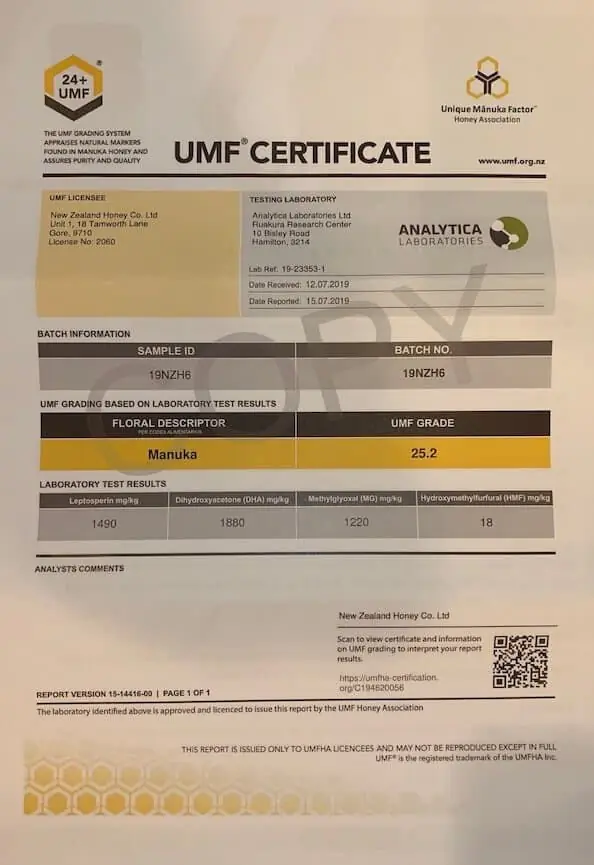
The UMF Honey Association is a New Zealand trade body. It licenses individual producers to use the UMF mark, requires per-batch testing at independent laboratories, and publishes a public licensee register at umf.org.nz. Every UMFHA-licensed jar carries a 4-digit licence number.
Is UMF the same as MGO?
No. MGO is a single chemical measurement. UMF is a four-marker certification calibrated against MGO and three other compounds. A jar can carry an MGO number without carrying UMF certification (Manuka Health does this). It cannot carry UMF certification without the underlying MGO content meeting the threshold. For the full side-by-side comparison, see UMF vs MGO.
What does UMF not measure?
UMF does not measure raw versus pasteurised, organic versus conventional, geographic origin within New Zealand, or any flavour attribute. It is purely an antibacterial-activity certification with authenticity verification. For other attributes, look for separate labelling.
Which UMF level should you buy?
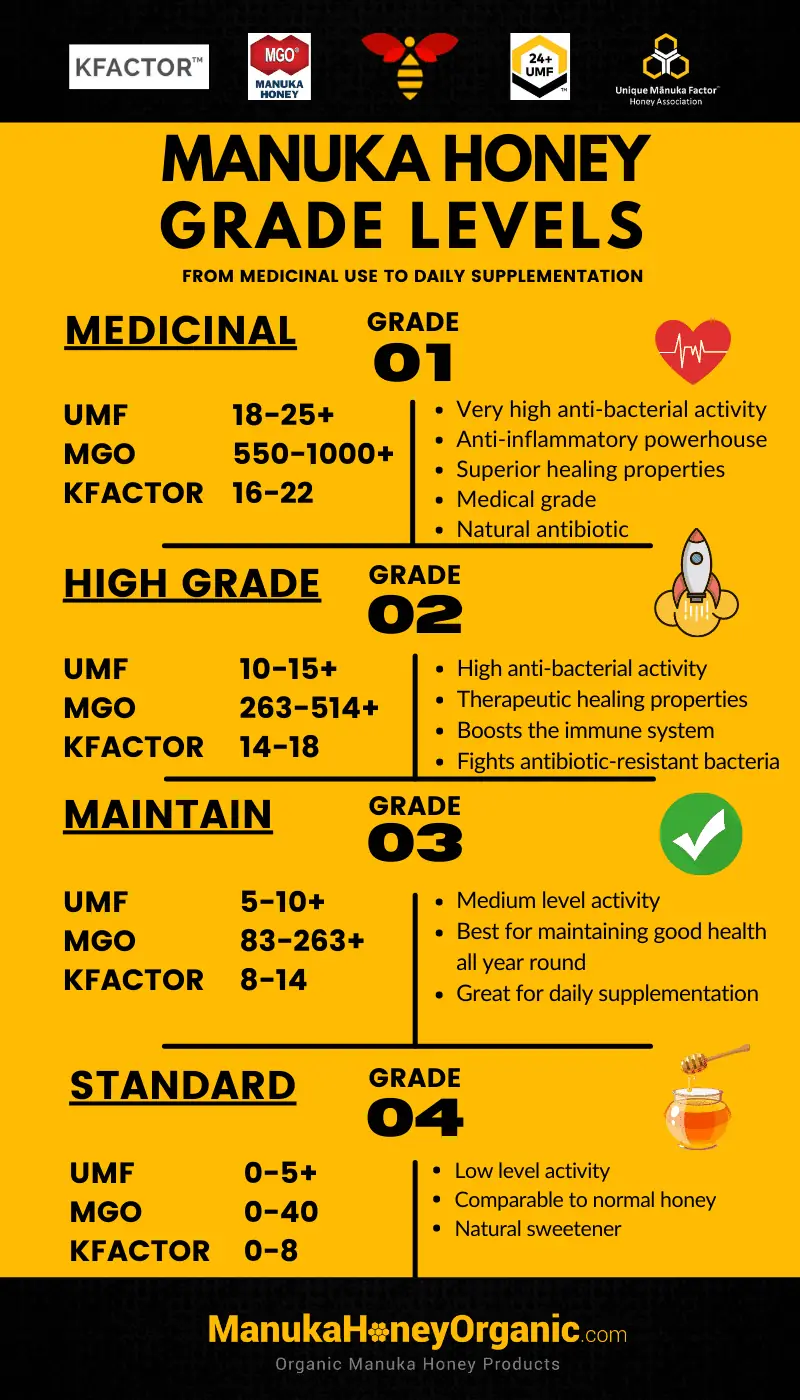
For daily sweetening or general culinary use, UMF 5+ to 10+ is sufficient and substantially cheaper. For the higher-MGO range studied in laboratory research, UMF 15+ or above. For research-aligned use cases, UMF 20+ corresponds to the MGO concentration most-cited in clinical literature. See our daily-use roundup and UMF 20+ roundup.
How is UMF related to NPA?
NPA (Non-Peroxide Activity) is the underlying biological property UMF measures. UMF is the certification grade; NPA is the laboratory measurement. They are nearly numerically identical (UMF 10+ ≈ NPA 10). See our NPA explainer for the full mechanism.
Common questions
Is higher UMF always better?
For specific antibacterial use cases, yes. For daily sweetening or culinary use, no. Higher UMF is significantly more expensive and the incremental potency is wasted on most consumer applications.
What if a jar says "Manuka" without a UMF number?
It has not been UMFHA-tested. It may still be real Manuka (the New Zealand MPI Manuka Honey Definition is a separate authenticity standard) but you cannot verify its antibacterial potency. See our fake honey guide.
Does UMF expire?
The UMF rating reflects the honey's properties at testing time. MGO content can continue to evolve in the jar after sale, generally drifting upward over the first 12-24 months as residual DHA continues to convert. The UMF certification number printed on the jar does not change.
For the brands currently UMFHA-certified at each tier, see our best Manuka honey roundup.