
What is MGO in Manuka Honey? Methylglyoxal Explained
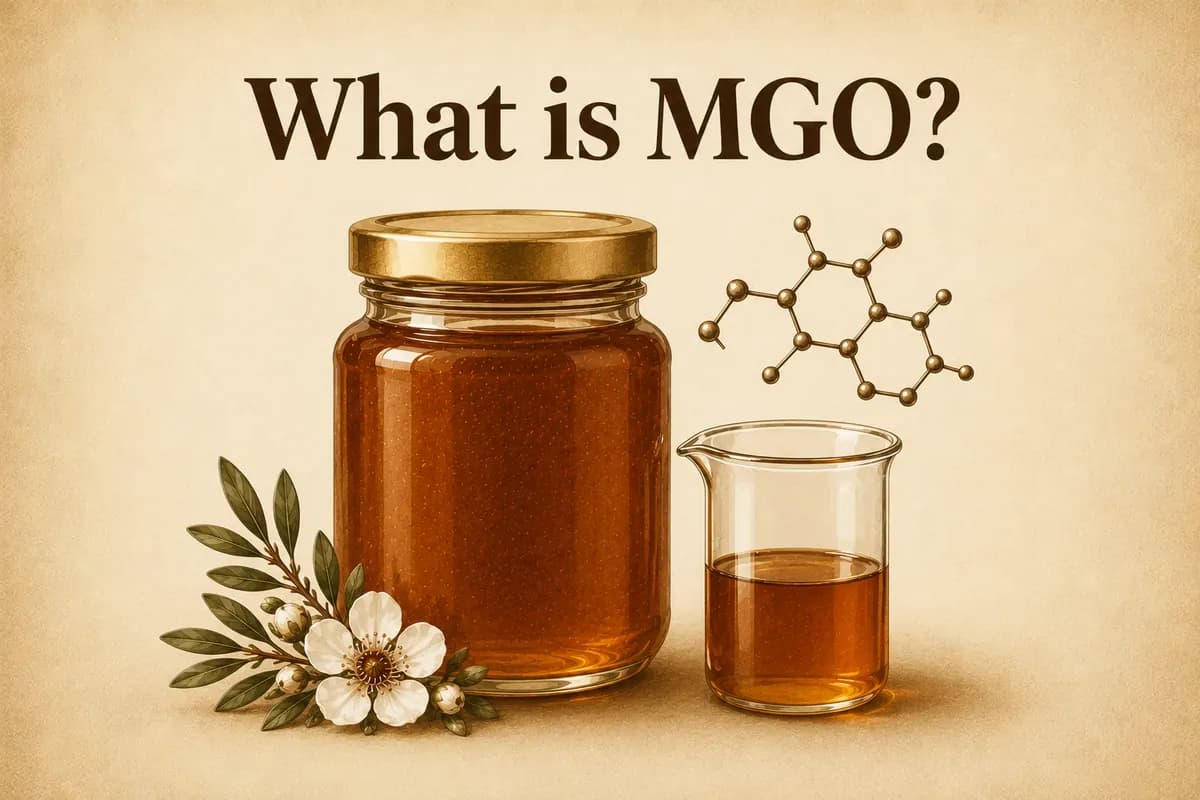
MGO (methylglyoxal) is the principal antibacterial compound in Manuka honey. It is a naturally-occurring alpha-oxoaldehyde that forms during honey maturation when dihydroxyacetone (DHA) in Manuka flower nectar slowly converts to MGO over 12 to 18 months. MGO is heat-stable and survives the conditions that destroy regular honey's antibacterial action.
How is MGO measured?
MGO is reported in milligrams per kilogram of honey (mg/kg). Independent laboratories test a sample of each batch using high-performance liquid chromatography (HPLC). The number on a Manuka jar's label corresponds to that batch's laboratory-measured MGO content at testing time.
What MGO levels are typical?
Commercial Manuka honey ranges from MGO 30 (multifloral, low-grade) to MGO 1200+ (premium, ultra-rare). The MGO content correlates directly with antibacterial activity in laboratory tests. Most consumers buy in the MGO 100 to 829 range.
| MGO content | Approximate UMF | Tier |
|---|---|---|
| 30 - 82 | Multifloral / not UMF | Table-grade |
| 83 - 262 | UMF 5+ | Mild |
| 263 - 513 | UMF 10+ | Moderate |
| 514 - 828 | UMF 15+ | High |
| 829 - 1121 | UMF 20+ | Premium |
| 1122+ | UMF 24+ | Ultra-premium |
Why does Manuka honey contain MGO when regular honey does not?
Manuka flower nectar is unusually rich in dihydroxyacetone (DHA). DHA converts to MGO during honey maturation. Regular honey contains essentially no DHA, so essentially no MGO. The amount of MGO in a finished Manuka jar is determined by the initial DHA concentration in the nectar plus the maturation time.
Is MGO from honey safe to eat?
Yes. Dietary MGO from honey is metabolised by the human body and has been consumed in honey for millennia. It is important to distinguish honey-derived MGO (consumed externally, beneficial antibacterial properties) from endogenous MGO (produced inside the body during glucose metabolism, associated with diabetic complications). The two are the same molecule but the contexts are different. People with diabetes should consult their physician.
How does MGO actually kill bacteria?
MGO is a reactive aldehyde. In laboratory tests, it disrupts bacterial cell wall and protein function. Mavric et al. (2008, Molecular Nutrition & Food Research) identified MGO as the dominant antibacterial constituent of New Zealand Manuka honey. Carter et al. (2016, Frontiers in Microbiology) summarised the broader laboratory evidence base across bacterial pathogens.
What is the difference between MGO rating and UMF rating?
MGO is a single chemical measurement. UMF is a four-marker certification (leptosperin, MGO, DHA, HMF) administered by the UMF Honey Association. UMF 10+ corresponds to roughly MGO 263. A jar may carry an MGO rating without UMF certification (Manuka Health does this); it cannot carry UMF without meeting the underlying MGO threshold. See our UMF explainer or the full UMF vs MGO comparison.
How is MGO different from hydrogen peroxide?
Hydrogen peroxide is the antibacterial mechanism in regular honey. It is unstable and degrades in light, heat, and stomach acid. MGO is stable in those same conditions. The activity that survives those conditions is called Non-Peroxide Activity (NPA), and it is what makes Manuka honey commercially distinctive. See our NPA explainer.
Common questions
Does MGO content increase over time in the jar?
Often slightly, yes. Residual DHA continues to convert to MGO during the first 12-24 months of shelf life. After that, MGO levels stabilise.
Does heating Manuka honey destroy the MGO?
Not at typical kitchen temperatures (tea, baking). MGO is heat-stable up to roughly 100°C. Prolonged exposure to higher temperatures can cause some degradation.
Is MGO the only antibacterial compound in Manuka?
No. MGO accounts for roughly half the antibacterial activity. The remainder is associated with other compounds, including leptosperin and methyl syringate.
Sources
- Mavric E, Wittmann S, Barth G, Henle T. Identification and quantification of methylglyoxal as the dominant antibacterial constituent of Leptospermum scoparium (Manuka) honeys from New Zealand. Molecular Nutrition & Food Research. 2008;52(4):483-9.
- Adams CJ, Manley-Harris M, Molan PC. The origin of methylglyoxal in New Zealand Manuka (Leptospermum scoparium) honey. Carbohydrate Research. 2009;344(8):1050-3.
- Carter DA, Blair SE, Cokcetin NN, et al. Therapeutic Manuka Honey: No Longer So Alternative. Frontiers in Microbiology. 2016;7:569.
For currently available Manuka jars at each MGO tier, see our tested-and-ranked roundup.