
What is NPA? Non-Peroxide Activity in Manuka Honey
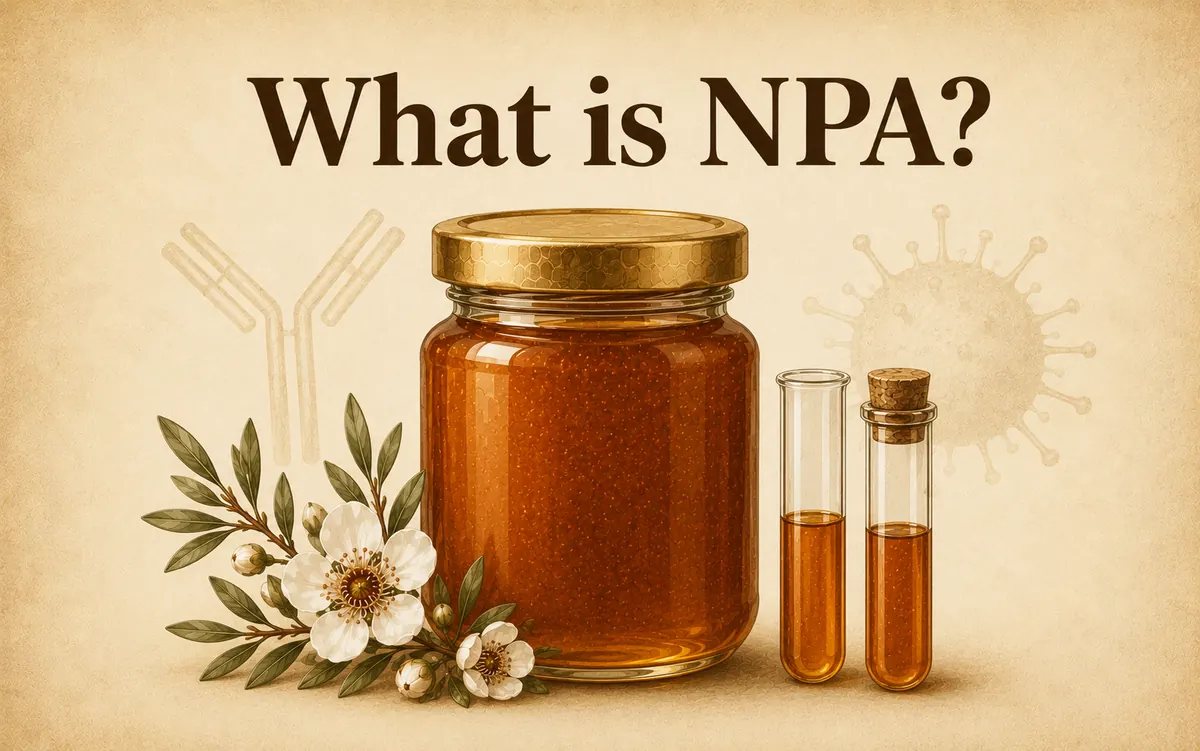
NPA (Non-Peroxide Activity) is the antibacterial property unique to Manuka honey. It comes from MGO (methylglyoxal) and survives the conditions that destroy regular honey's antibacterial action.
What is Non-Peroxide Activity?
Non-Peroxide Activity is the part of a honey's antibacterial effect that does not depend on hydrogen peroxide. It is measured against a reference disinfectant (usually phenol) and expressed as a percentage. An NPA of 10 means the honey is roughly as antibacterial as a 10% phenol solution.
How NPA differs from regular honey's antibacterial action
All honey contains some hydrogen peroxide, produced when bees add the enzyme glucose oxidase to nectar. Hydrogen peroxide is antibacterial but unstable. It breaks down in light, in heat, when the honey is diluted, and in the human stomach.
Manuka honey has a second antibacterial mechanism that does not break down in those conditions. That second mechanism is what NPA measures. Manuka can sit on a kitchen counter, get warmed in tea, or be diluted in water and still retain antibacterial activity. Regular honey cannot.
What drives NPA?
The principal driver is methylglyoxal (MGO), a compound that forms during 12 to 18 months of honey maturation. MGO comes from dihydroxyacetone (DHA), which is found in the nectar of the Manuka flower (Leptospermum scoparium). As the honey ages in storage, DHA gradually converts to MGO. The longer the maturation, the higher the MGO content, the higher the NPA.
Research from the University of Waikato Honey Research Unit and Professor Thomas Henle's group at TU Dresden established MGO as the primary contributor. Approximately half of Manuka honey's antibacterial potency is attributed to MGO. The remainder is associated with other compounds, including leptosperin (a marker used for authentication) and methyl syringate.
NPA, MGO, and UMF: how the ratings relate
Three rating systems describe the same underlying property from different angles.
- NPA measures antibacterial activity directly, against a phenol reference. Reported as a number, e.g. NPA 10.
- MGO measures the methylglyoxal content of the honey. Reported in mg/kg, e.g. MGO 514.
- UMF (Unique Manuka Factor) is the certification grade administered by the UMF Honey Association. It is calibrated against NPA and is the only rating that also requires authenticity testing (leptosperin, DHA, HMF).
UMF 10+ corresponds approximately to NPA 10 and MGO 263. UMF 20+ corresponds to NPA 20 and MGO 829. The relationships are not perfectly linear because UMF tests four compounds while MGO and NPA each test one.
Why NPA matters when buying Manuka honey
NPA is the property a buyer is paying for. A jar of Manuka honey labelled UMF 5+ has roughly the same MGO content as some non-Manuka honeys. A jar labelled UMF 20+ does not. The price premium of high-grade Manuka tracks NPA, not the geographic origin or the floral source alone.
If a Manuka honey product is labelled without an NPA, MGO, or UMF rating, it has not been tested for antibacterial activity. It may still be Manuka honey; it may not be high-NPA Manuka honey.
Common questions
Is NPA stable when the honey is heated?
Yes. NPA is heat-stable up to typical baking and tea-drinking temperatures. The hydrogen-peroxide component of regular honey is not.
Does NPA degrade over time?
NPA is more stable than the peroxide component of regular honey but is not infinite. MGO content can continue to evolve in the jar after sale. Most labels print a "best before" date 2 to 4 years after packing. The antibacterial activity remains substantial through that window.
Is NPA the same as UMF?
No. NPA is a measurement; UMF is a certification grade calibrated against NPA. UMF certification also tests for leptosperin, DHA, and HMF, which NPA on its own does not.
Why is "Non-Peroxide" the framing?
Researchers in the 1980s established that Manuka honey's antibacterial activity persisted after the addition of catalase, an enzyme that destroys hydrogen peroxide. The activity that remained was, by definition, "non-peroxide." The name has stuck even after MGO was identified as the principal driver.
Sources and references
Key research sources for this article: the University of Waikato Honey Research Unit (Adams, Mavric, Snow et al.), Professor Thomas Henle (TU Dresden, identified MGO as the principal antibacterial compound, 2008), and the UMF Honey Association's published certification standards.