
What is Manuka Honey? The Complete Guide
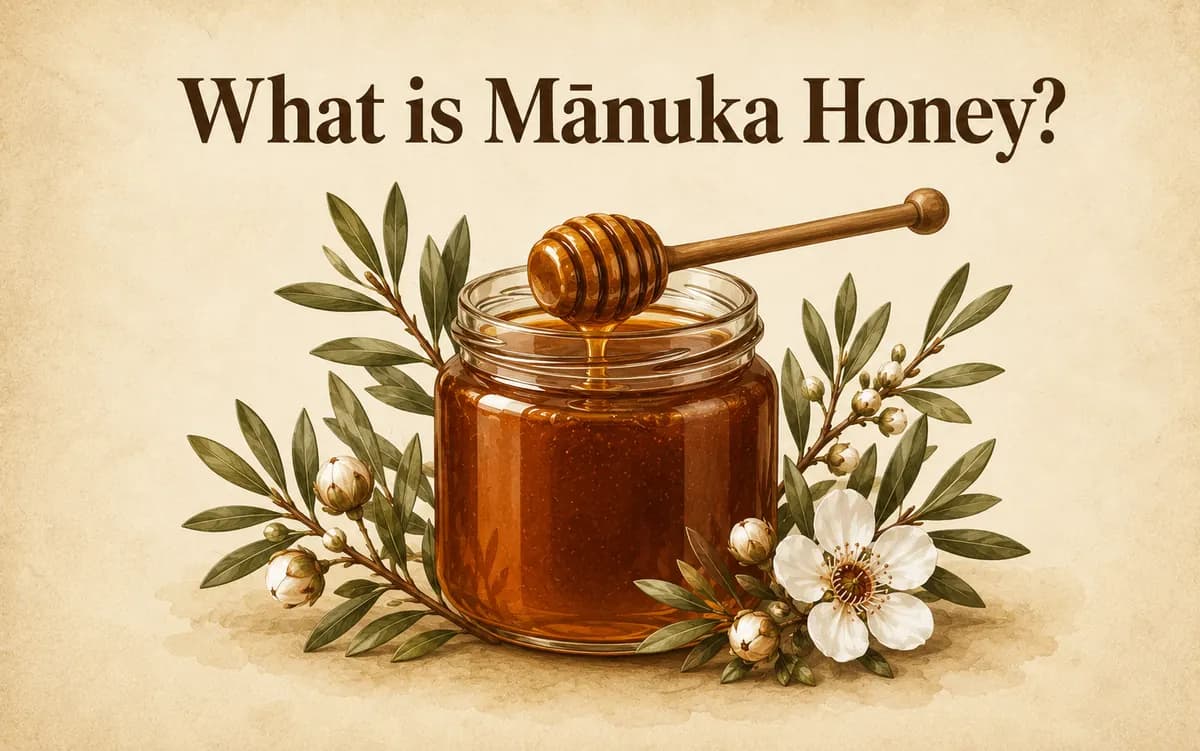
Manuka honey is monofloral honey produced by bees from the Manuka tree (Leptospermum scoparium), native to New Zealand. Its defining property is non-peroxide antibacterial activity driven by the compound methylglyoxal (MGO). Real Manuka honey is produced commercially only in New Zealand and Australia, and only New Zealand operates a national regulatory standard for the label.
What makes Manuka honey different from regular honey?
Regular honey's antibacterial action depends on hydrogen peroxide, which degrades in light, heat, and stomach acid. Manuka honey has a second mechanism, driven by methylglyoxal (MGO), that is heat-stable and survives those conditions. This stable activity is called Non-Peroxide Activity (NPA).
Where does Manuka honey come from?
The Manuka tree (Leptospermum scoparium) is native to New Zealand and parts of southeastern Australia. Bees gather nectar during a 4-6 week flowering window each summer. The nectar contains dihydroxyacetone (DHA), which converts to MGO during 12-18 months of honey maturation. See our manuka tree guide.
Who certifies Manuka honey as authentic?
Two bodies matter. The New Zealand Ministry for Primary Industries (MPI) operates a mandatory legal definition for the "monofloral Manuka" export label, testing four chemical markers plus a Manuka pollen DNA marker. The UMF Honey Association (UMFHA) operates a voluntary trade certification that adds antibacterial-activity testing (MGO, leptosperin, DHA, HMF). UMFHA certification is the stronger consumer trust signal.
How is Manuka honey graded?
Three grading systems are in commercial use:
- UMF (Unique Manuka Factor): UMFHA-administered four-marker certification. Most rigorous.
- MGO rating: Direct methylglyoxal content in mg/kg. Used by Manuka Health and others.
- NPA (Non-Peroxide Activity): Direct laboratory measurement against phenol reference. Less common on retail labels.
- KFactor: Wedderspoon's proprietary system measuring monofloral status and traceability, not antibacterial activity directly.
For the full conversion table between UMF, MGO, and NPA, see our UMF explainer.
What is Manuka honey used for?
Manuka honey is used as a culinary sweetener (like any honey), as a topical wound dressing in clinical settings (sterile medical-grade products), and as a daily wellness supplement. The clinical research base is concentrated in topical applications. Drinking Manuka honey for systemic effects has weak research support.
Is all Manuka honey antibacterial?
No. Multifloral Manuka and table-grade Manuka have low MGO content and antibacterial activity comparable to regular honey. UMF-certified or MGO-rated Manuka has the documented antibacterial activity that defines the category. A "Manuka honey" label without UMF or MGO numbers does not guarantee any specific antibacterial potency.
What does Manuka honey taste like?
Manuka honey is darker, denser, and earthier than typical clover honey. Higher-MGO Manuka tends to have a stronger medicinal-bitter back-note. Lower-MGO Manuka is sweeter and more accessible. Manuka often crystallises in the jar (a normal physical change, not a quality issue).
Is Manuka honey safe for everyone?
Honey of any kind should not be given to infants under 12 months because of the risk of botulism. People with diabetes should account for the carbohydrate load. People with fructose malabsorption or IBS may experience worsened symptoms. Pregnant adults can generally consume Manuka but should consult their healthcare provider for specific use cases.
Common questions
Is "Manuka" the same as "Manuka"?
Same word. "Manuka" is the Maori spelling with the macron, increasingly used by New Zealand brands as a sign of cultural respect. The product is identical.
How long does Manuka honey keep?
Indefinitely, in practical terms. Honey does not spoil under normal storage conditions. Manuka may crystallise over time; warming gently in water restores liquid texture.
Can I buy Manuka honey in the US?
Yes. Major retailers (Whole Foods, Costco, Amazon) stock it. See our tested roundup for current options.