
The Manuka Tree: Leptospermum scoparium and Its Honey
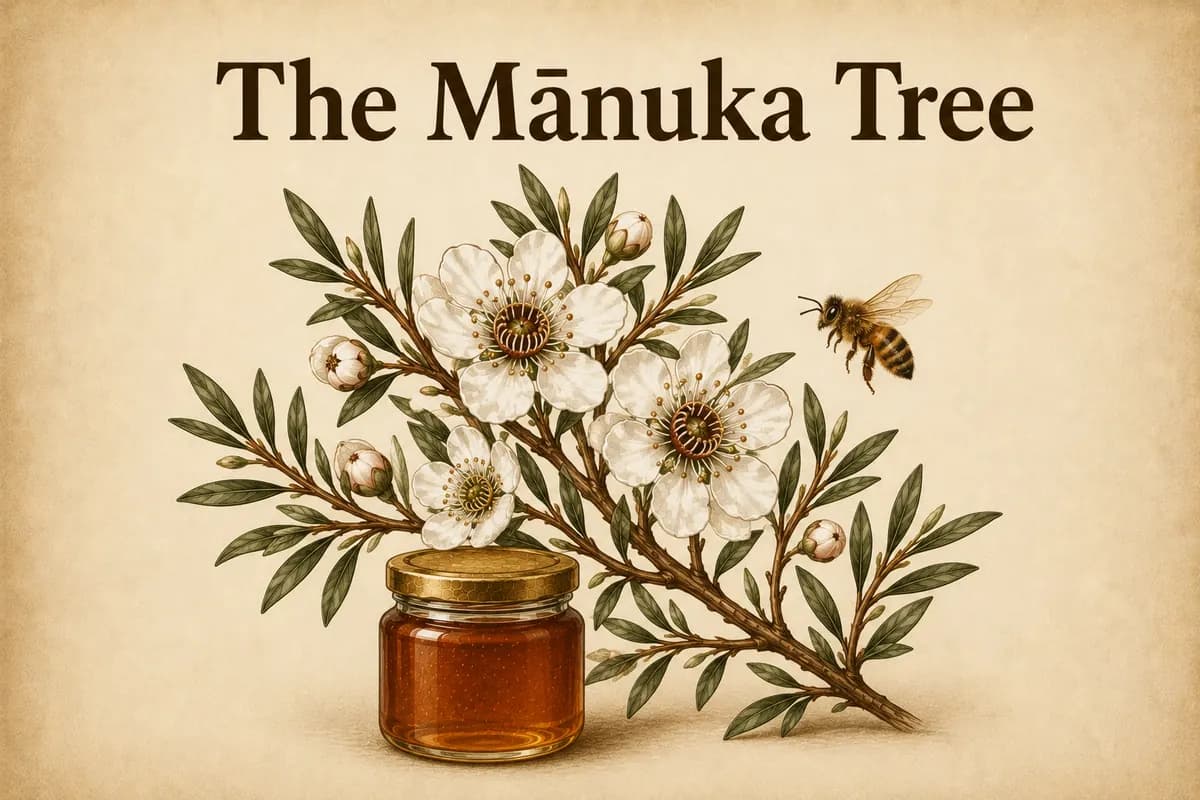
The Manuka tree (Leptospermum scoparium) is a small evergreen native to New Zealand and parts of southeastern Australia. It is the source of all real Manuka honey, and its nectar contains the precursor compound (DHA) that converts to methylglyoxal during honey maturation.
What does the Manuka tree look like?
Manuka grows as a shrub or small tree, typically 2-5 metres tall, occasionally reaching 15 metres in optimal conditions. The leaves are small, sharp, and aromatic. The flowers are small (about 1 cm across), white with red centres, and bloom in dense clusters during the New Zealand summer (December to February).
Where does the Manuka tree grow?
Manuka is native to New Zealand and parts of southeastern Australia (Tasmania, Victoria, New South Wales). Within New Zealand, the largest commercial Manuka regions are East Cape, Northland, Coromandel, and Bay of Plenty in the North Island, plus Marlborough Sounds in the South Island. The plant is hardy and grows on a wide range of soils, including poor and rocky terrain.
What is the difference between Manuka and Kanuka?
Manuka (Leptospermum scoparium) and Kanuka (Kunzea ericoides) are different plants in the same family (Myrtaceae). They often grow side by side and look similar at a distance. Manuka has larger flowers (about 1 cm) and pricklier leaves. Kanuka has smaller flowers in larger clusters and softer foliage. Bee research can usually distinguish their honeys via pollen morphology and chemical markers.
Why does Manuka honey have antibacterial activity but Kanuka honey does not?
Manuka flower nectar is unusually rich in dihydroxyacetone (DHA), which converts to methylglyoxal (MGO) during honey storage. Kanuka nectar contains far less DHA, so finished Kanuka honey has minimal MGO. The plants are botanical cousins; their honey chemistry is materially different.
How does Manuka tree DHA become honey MGO?
Bees collect Manuka nectar (rich in DHA) and convert it to honey through their enzymatic processes. The DHA remains intact in the fresh honey. Over 12-18 months of storage, DHA gradually converts to MGO in a non-enzymatic chemical reaction. The longer the maturation, the more MGO. See our MGO explainer.
What was the Manuka tree used for traditionally?
Maori people used Manuka extensively. The bark was used for tools and containers; the wood for paddles, spears, and weapons; an infusion of the leaves was used as a beverage and tonic; and the flowers and seed capsules had ceremonial uses. Captain James Cook's crew, who used a Manuka leaf infusion as a tea-substitute on his 1769 voyage, gave the plant its English alternative name "tea tree."
Can you grow your own Manuka tree?
Manuka trees are sold by specialty nurseries in temperate climates. They prefer well-drained acidic soil and full sun. They are tolerant of frost, drought, and poor soils. Note that growing the tree does not produce Manuka honey in any meaningful way without commercial-scale beekeeping operations alongside.
Common questions
Is Manuka the same as the tea tree used in tea tree oil?
No. Tea tree oil comes from Melaleuca alternifolia, an Australian plant. The "tea tree" name is shared with Manuka because Cook's crew used Manuka leaves to brew tea, but the plants are botanically distinct.
Why is it spelled with the macron (Manuka) sometimes?
"Manuka" is the Maori spelling. New Zealand brands increasingly use the macronned form as a sign of cultural respect for the indigenous origins of the plant and the honey.
Is Australian Manuka the same plant?
Australia has multiple Leptospermum species, several of which produce Manuka honey by the same mechanism. Leptospermum scoparium grows in both countries; Australia also has L. polygalifolium and others that produce comparable honeys.