
New Zealand Honey Varieties: Manuka, Kanuka, Rewarewa, and Others
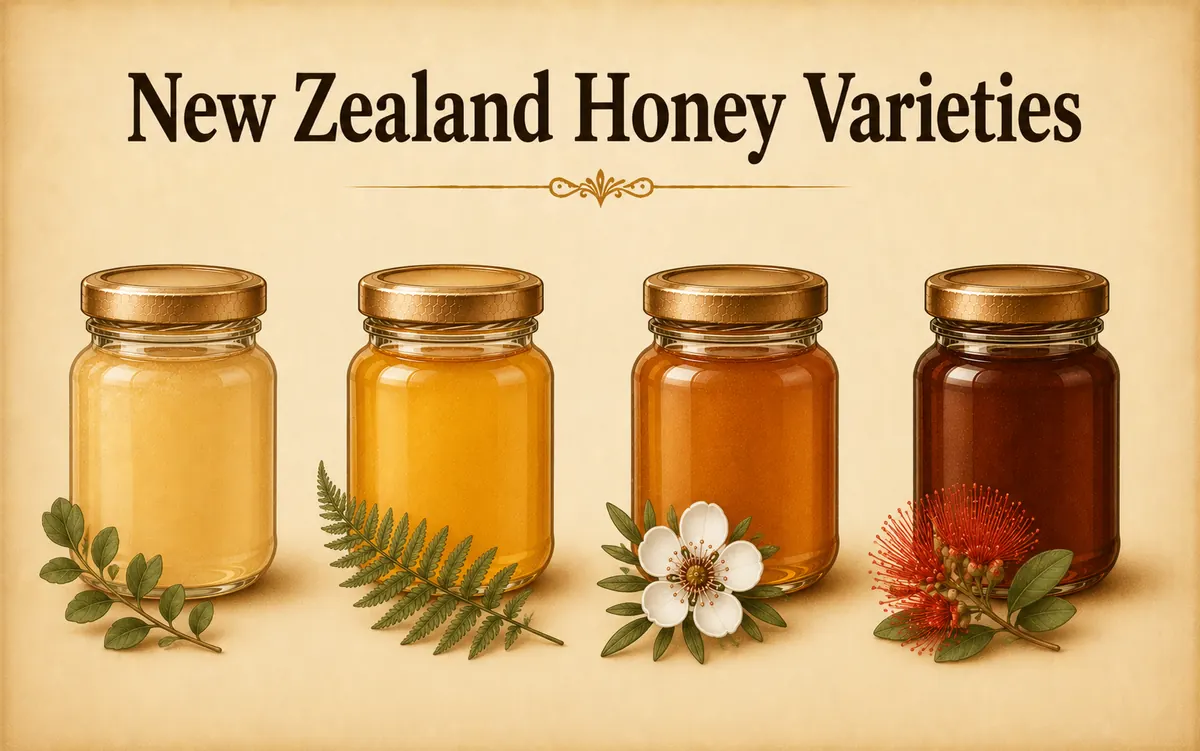
New Zealand produces over a dozen distinct monofloral honeys. Manuka is the most internationally famous, but the country's beekeepers also produce Kanuka, Rewarewa, Kamahi, Pohutukawa, Beech honeydew, Tawari, Rata, and several others. This is a guide to the major varieties and how Manuka fits among them.
What is the most famous New Zealand honey?
Manuka honey is the most famous, produced from the nectar of Leptospermum scoparium. It is the only New Zealand honey with a national regulatory definition (the MPI Manuka Honey Definition) and the only one with a major international trade-certification mark (UMFHA's UMF rating).
The major New Zealand monofloral honeys
Each variety has a distinct flavour profile, geographic source, and chemical signature:
| Variety | Source plant | Flavour profile | Distinctive trait |
|---|---|---|---|
| Manuka | Leptospermum scoparium | Earthy, medicinal, slightly bitter | Non-peroxide antibacterial activity (MGO) |
| Kanuka | Kunzea ericoides | Lighter, more floral than Manuka | Often confused with Manuka; closely related plant |
| Rewarewa | Knightia excelsa | Dark, malty, with caramel notes | Highest antioxidant content of NZ honeys |
| Kamahi | Weinmannia racemosa | Buttery, mild, smooth | South Island specialty |
| Pohutukawa | Metrosideros excelsa | Salty-sweet, smooth, white-cream colour | Coastal North Island; rare |
| Beech honeydew | Nothofagus species | Dark, malty, complex | Not from nectar; from sap-feeding scale insects |
| Tawari | Ixerba brexioides | Butterscotch, distinctive | Rare; only North Island |
Why does Manuka command higher prices than the others?
Manuka commands a price premium because of its measurable, documented non-peroxide antibacterial activity. The other New Zealand monoflorals are excellent honeys with distinct flavour profiles, but they do not have the same laboratory-verifiable antibacterial property. Rewarewa, for example, has high antioxidant content (which is different from antibacterial activity) and is gaining premium positioning, but at a fraction of Manuka's price.
Is Kanuka the same as Manuka?
No. They are different plants in the same family (Myrtaceae). Manuka is Leptospermum scoparium; Kanuka is Kunzea ericoides. Their honeys are similar in appearance, and the plants often grow side by side, but Manuka has the high MGO content that defines its commercial reputation.
Where can you buy New Zealand non-Manuka honey in the US?
Specialty importers (Hammerschlag, Honey Tree of NZ) and some direct-to-consumer brands (Tahi, Wild Cape) carry Rewarewa and Kamahi alongside Manuka. Major US retail outlets typically only stock Manuka.
Best Manuka brands from New Zealand
For the verified-origin, UMFHA-certified Manuka brands currently available, see our Best Manuka Honey from New Zealand roundup. For the master roundup across all evaluated brands, see our top picks.
Common questions
Is non-Manuka New Zealand honey worth buying?
For flavour, yes. Rewarewa and Pohutukawa in particular are exceptional culinary honeys. For antibacterial use cases, Manuka is the variety with the documented mechanism.
What is the rarest New Zealand honey?
Pohutukawa and Tawari are among the rarest commercial varieties, both highly localised in production and limited in volume.
Does honeydew honey have antibacterial activity?
Beech honeydew has some peroxide-driven antibacterial activity, but lacks the heat-stable non-peroxide activity that distinguishes Manuka.