
Multifloral vs Monofloral Honey: The Real Difference
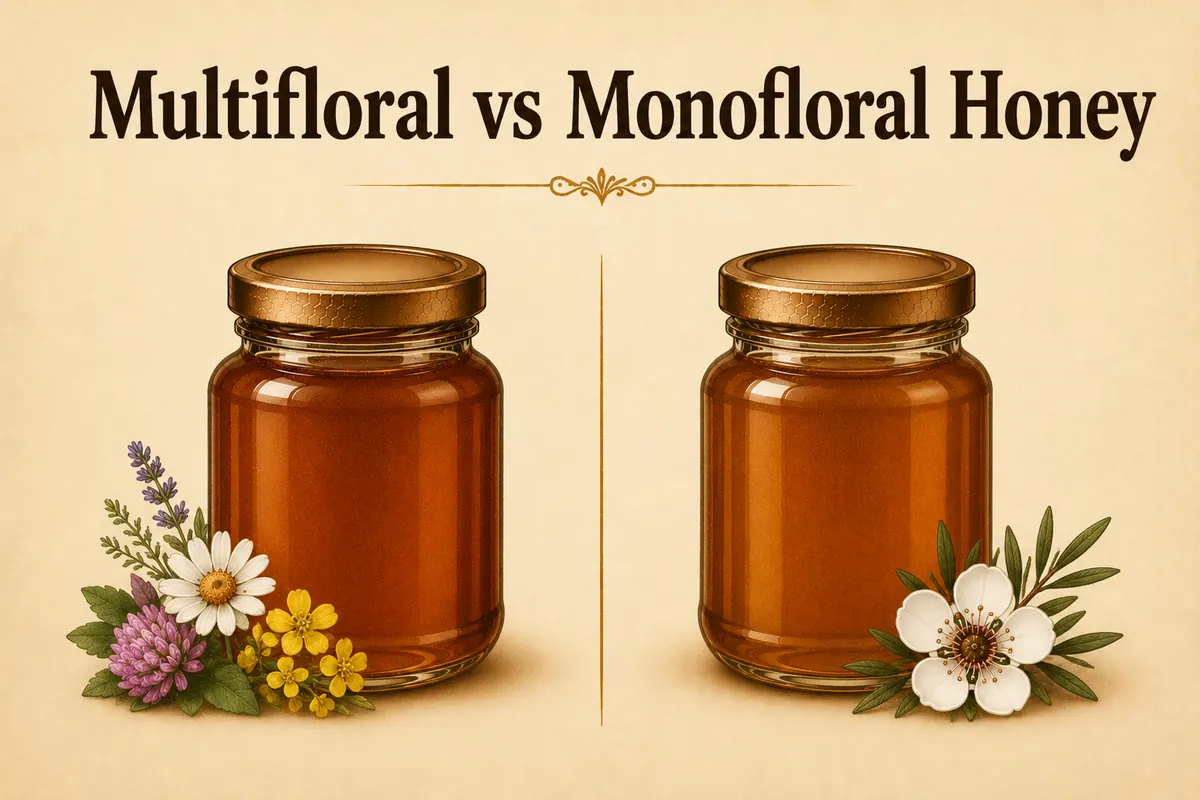
Monofloral honey comes from bees foraging predominantly on one species of flower. Multifloral honey comes from bees foraging on a mix of flowers. The distinction is not absolute (no honey is purely from one species), but for premium honeys like Manuka the monofloral threshold is what drives both certification and price.
What does monofloral mean in practice?
Monofloral honey contains a dominant pollen and chemical signature from a single floral source. The threshold varies by country and certification body. The New Zealand MPI Manuka Honey Definition requires specific chemical-marker thresholds plus DNA-marker presence to qualify a honey as monofloral Manuka.
How is monofloral honey produced?
Beekeepers move hives to areas where one species dominates the local flora during peak bloom. For Manuka, this means transporting hives to remote Manuka-rich areas during the 4-6 week summer flowering window. Bees forage within roughly a 3 km radius, so site selection determines floral source.
Why does monofloral honey cost more than multifloral?
Three reasons. Production volume per hive is lower (bees have fewer flowers to choose from). Hive transportation and site management add cost. Verification testing (chemical and pollen analysis) is expensive. Multifloral honey, by contrast, can be produced in standard commercial apiaries year-round.
What honeys are commonly sold as monofloral?
| Honey | Source plant | Distinctive trait |
|---|---|---|
| Manuka | Leptospermum scoparium | Non-peroxide antibacterial activity |
| Acacia | Robinia pseudoacacia | Slow to crystallise; mild flavour |
| Buckwheat | Fagopyrum esculentum | Dark, malty, high in antioxidants |
| Tupelo | Nyssa ogeche | Buttery, very slow to crystallise |
| Sourwood | Oxydendrum arboreum | Caramel notes; Appalachian specialty |
| Linden / Lime | Tilia species | Minty, almost herbal |
| Orange Blossom | Citrus species | Light, citrus aroma |
| Heather | Calluna vulgaris | Thixotropic; thick when stationary |
Is multifloral honey lower quality?
No. Multifloral honey can be excellent. The trade-off is consistency: multifloral varies batch-to-batch in flavour, colour, and chemistry, while monofloral aims for repeatable characteristics. For specific properties (antibacterial activity, low-glycemic profile, particular flavour), monofloral is the more reliable choice.
Is multifloral Manuka the same as monofloral Manuka?
No. Multifloral Manuka has Manuka as one of several floral sources but does not meet the MPI threshold for the monofloral label. Multifloral Manuka has lower MGO content and lower antibacterial activity than monofloral. Many "Manuka honey" products at lower prices are multifloral, not monofloral.
Common questions
Can a honey be 100% from one flower?
Practically, no. Bees forage opportunistically. Even at peak bloom, a small percentage of nectar comes from secondary sources. "Monofloral" is a threshold, not a purity claim.
Why does Manuka have two monofloral grades?
The MPI definition has both "monofloral Manuka" and "multifloral Manuka" categories with different chemical-marker thresholds. The labels distinguish honey with predominantly Manuka nectar from honey with significant Manuka but mixed sources.
Which monofloral honey is the most expensive?
Manuka, by a wide margin. Premium UMF 24+ Manuka can exceed $500 per 250 g jar. Other monoflorals rarely exceed $50 per jar.
For more on the monofloral Manuka category specifically, see our monofloral Manuka guide.